A stainless-steel cubicle name does not tell you whether the system will survive steam, condensation, sweat, chlorine, hard-water deposits, or aggressive cleaning. By the end, you will know which material, construction, drainage, ventilation, maintenance, and supplier documents to require before approving CW PureEx SS for a wet commercial facility.
Key takeaways
- Do not approve sauna use without documented alloy, temperature and humidity limits.
- Specify sealed edges, corrosion-resistant fixings and a floor drainage strategy.
- Compare quotations by alloy grade, panel core, hardware and installation scope.
- Inspect alignment, seals, drainage clearances and finish before handover.
Is CW PureEx SS suitable for a sauna or high-humidity restroom?
CW PureEx SS cannot be approved for sauna, steam-room, shower, or wet changing-room use from its trade name alone. “Stainless steel” and “rust-proof” do not identify the alloy, temperature limit, humidity limit, or chloride exposure limit.
A traditional sauna combines high temperature with intermittent moisture. A steam room or poorly ventilated restroom is more severe: near-condensing humidity lets water remain in crevices, behind floor shoes, and along unsealed cut edges. Trapped water causes more damage than the room’s average humidity suggests.
SS 304 suits ordinary atmospheric moisture. SS 316 or 316L is the more conservative choice where chlorides come from perspiration, salt-based cleaners, pool or spa aerosols, coastal air, or repeated hypochlorite use. Molybdenum gives 316 better resistance to localized pitting, but 316 is not immune to chloride attack.
For a CW PureEx SS for toilet cubicle supplier in Pune quotation, require these details:
- SS 304 or SS 316/316L grade
- Sheet thickness and finish
- Core construction and complete-panel build-up
- Hardware, brackets, hinges, screws, and fastener grade
- Maximum temperature, humidity, and stated exposure limit
- Cleaning chemicals permitted and prohibited
A stainless steel toilet cubicle supplier in Pune should provide a complete joint sample, not only a loose sheet. Do not approve the system until the quotation states the grade and exposure limit; reject “stainless steel” or “rust-proof” as incomplete specifications.
Which panel and fixing details matter in a wet-room installation?
A quotation for a commercial cubicle partition in Pune is incomplete unless it defines the entire assembly, not just a stainless face. Ask for these items in writing:
- Stainless sheet thickness and overall panel thickness; solid stainless construction or composite construction.
- Core type: honeycomb, mineral, plywood, compact laminate, or another material; include the adhesive.
- Door thickness, support-leg material, headrail or ceiling bracing, and partition-to-floor clearance.
- Wall-fixing method, floor-shoe design, brackets, hinges, indicator bolts, coat hooks, screws, and anchor-fastener material and grade.
- Stainless fixings identified by grade, with isolating washers where stainless touches aluminium, mild steel, or another dissimilar metal.
- A stated post-fabrication cleaning and passivation method following ASTM A967/A967M or ASTM A380/A380M practices.
| Construction | What the stainless face does not prove | What to demand |
|---|---|---|
| Solid stainless | Face and body are the same material | Grade, sheet thickness, weld treatment |
| Honeycomb, mineral, or plywood core | Fire, impact, and moisture behaviour depends heavily on the core and adhesive | Complete-panel test evidence |
| Compact-laminate core | The skin does not establish laminate water resistance or edge durability | Core specification and sealed-edge detail |
Require complete-panel fire classification under the applicable standard, such as EN 13501-1, when fire performance matters. Inspect overlaps, cut edges, welds, concealed supports, and water-holding floor shoes: these crevices trap deposits and start pitting or crevice corrosion. A loose sheet sample proves little; approve a complete joint sample with its wall, floor, and hardware interfaces.
How should the finish, drainage, ventilation, and cleaning plan be chosen?
Choose the finish by cleaning workload, not appearance. A commercial toilet cubicle supplier in Pune must provide a physical sample, not a catalogue photograph.
| Finish | Maintenance consequence | Decision |
|---|---|---|
| Brushed or satin | Directional grain shows replacement mismatch, scratches, weld heat tint, and water marks | Specify grain direction and consistent weld treatment |
| Mirror-polished | Wipes clean readily, but fingerprints, scratches, and dried droplets are conspicuous | Use only where frequent wiping is planned |
| Powder-coated | Hides fingerprints but chips expose the substrate and make local repairs visible | Reject without coating-thickness and repair details |
| Anti-fingerprint | Reduces marks, but chemical compatibility and recoating limits require proof | Approve after finish-specific chemical trials |
The sample must show grain direction, weld treatment, edge finishing, and expected water-mark and scratch visibility. Do not approve a colour card or photograph.
Coordinate floor falls, floor traps, wet-room thresholds, service ducts, wall-plumb tolerances, sauna heaters, shower spray zones, and inspection access before fabrication. A floor-to-ceiling seal can hide leaks; an excessive floor gap transfers spray and weakens privacy. Set the gap from drainage, cleaning, accessibility, and privacy requirements.
Write the cleaning method into the handover plan:
- Dilute hypochlorite to the chemical manufacturer’s instruction.
- Observe the stated contact time, then rinse and dry the steel.
- Trial every chemical on the specified finish before approval.
- Prohibit abrasive pads that embed iron.
Provide extraction and make-up air for steam rooms and poorly ventilated restrooms. Dry concealed joints, floor shoes, and service voids; an average humidity reading cannot prove that trapped condensation has evaporated.
How do you compare a Pune supplier’s quotation for this application?
Compare a quotation from a toilet cubicle supplier in Pune only after converting every offer to the same measurable specification. A low price can reflect thinner panels, wider support spacing, weaker hardware, or a different core rather than better value.
| Item | Normalize in every quotation | Reject or clarify |
|---|---|---|
| Material | SS 304 or SS 316/316L grade, sheet and panel thickness, solid or composite core | “Stainless steel” with no grade or thickness |
| Construction | Finish, grain direction, edge treatment, joint detail, support spacing, headrail or ceiling bracing | Catalogue image without a physical finish sample |
| Installation | Wall and floor fixing, hardware grade, installation tolerances, floor clearance, packer, sealant, adjustment, and wall-out-of-plumb method | No stated correction method for uneven wet-room walls |
| Commercial terms | Warranty exclusions, chemical-cleaning conditions, repair responsibility, and handover inspection | Warranty that excludes cleaning chemicals, moisture, hardware, or sealant |
Before site work, require the supplier to document how packers, sealants, adjustments, and out-of-plumb walls will be handled. Without that method, wet-room walls can leave open joints, stress hinges, and create water-retaining gaps.
- Request a complete joint sample, not a loose stainless sheet. Inspect interfaces where stainless meets aluminium, mild steel, masonry, and the wet floor; require isolation details and drainage.
- Require site measurement, installation coordination, and a signed handover inspection covering alignment, door operation, clearances, sealant, drainage, and finish.
Cubicle World industries Pvt Ltd is relevant to a project only when it provides these submittals and accepts those checks; a branded product name alone does not prove sauna suitability.
Related product
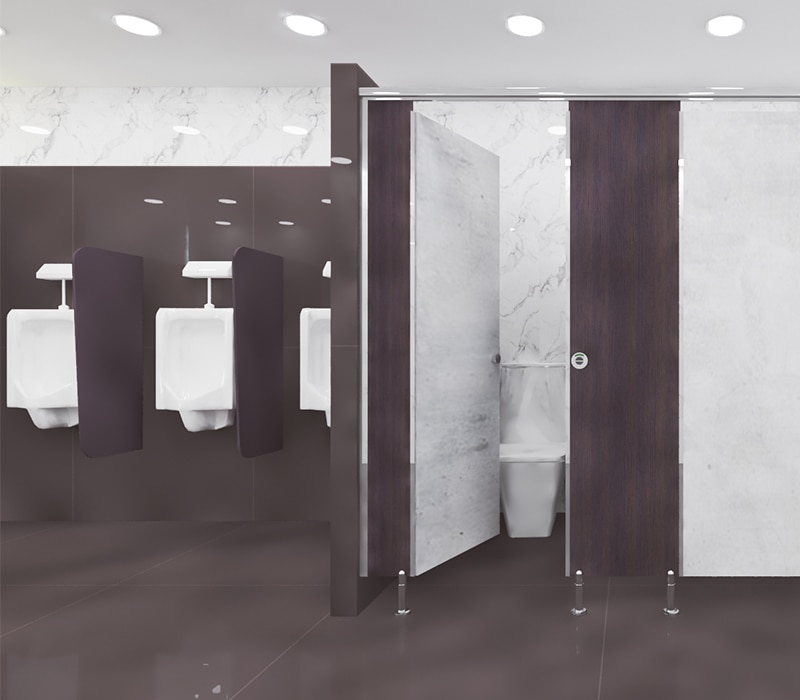 | Restroom Cubicles PRODUCT DESCRIPTION CW Leg Series in Stainless Steel variant is developed for providing higher endurance and spectacular design. View product → |
What should you inspect before accepting the completed cubicles?
1. Match the delivered steel to the quotation. Check the material test certificate, heat number, or traceability mark against the approved SS 304 or SS 316/316L grade. Measure panel and sheet thickness at several locations, then inspect grain direction, scratches, weld discoloration, heat tint, cut edges, and finish consistency.
2. Inspect every interface, not just the visible face. Check sealant joints, floor shoes, concealed supports, wall connections, and drainage access for open gaps or trapped water. Confirm that no plated-carbon-steel screw, ordinary mild-steel bracket, aluminium contact, or incompatible fastener has replaced the specified stainless hardware.
3. Operate every door, hinge, lock, indicator bolt, coat hook, and adjustable support. Check door clearances, privacy gaps, panel alignment, hinge loading, wall-out-of-plumb adjustments, and the agreed floor clearance. A polished sample cannot reveal a stressed hinge or a shoe that holds wash water.
4. Run the facility’s cleaning demonstration before approval. Use the intended disinfectant and hypochlorite dilution, observe its stated contact time, rinse, and dry the steel. Inspect the finish for staining, dull patches, pitting, and trapped water; reject abrasive pads that can embed iron.
5. Put the approved grade, finish and grain direction, chemical schedule, ventilation requirements, repair procedure, warranty exclusions, and replacement-panel finish direction in the handover file. The phrase CW Pureex SS for toilet cubicle supplier in Pune proves nothing without these records. Approve the stainless steel toilet cubicle supplier in Pune only after every check passes.
Frequently asked questions
Is CW PureEx SS suitable for a sauna or high-humidity restroom?
Its trade name alone cannot confirm suitability. Ask the supplier for the stainless-steel grade, temperature limit, humidity exposure limit and chloride-exposure guidance before approving sauna, steam-room, shower or wet changing-room use.
Which panel and fixing details matter in a wet-room installation?
Confirm the panel construction, stainless-steel grade, edge treatment, joint sealing, anchoring method and fastener grade. Check that the design prevents water entering panel edges and keeps fixings away from standing water.
How should the finish, drainage, ventilation and cleaning plan be chosen?
Choose a finish that tolerates the cleaning chemicals used onsite, provide falls and drainage that prevent standing water, and coordinate ventilation with the room’s heat and moisture load. Obtain the supplier’s cleaning instructions in writing.
How do you compare a Pune supplier’s quotation for this application?
Compare the alloy and panel specification, hardware, seals, supports, ventilation or drainage interfaces, installation, testing, warranty and exclusions—not only the price per cubicle.
What should you inspect before accepting the completed cubicles?
Check panel identity, plumb and level alignment, door operation, clearances, anchor tightness, sealed joints, surface damage, drainage access and cleanability. Record defects before signing handover.