A tier count tells you how many doors fit into a bay, but it does not tell you whether a motorcycle helmet, backpack or folded uniform will fit inside. By comparing compartment geometry, user demand, site constraints, materials, locks and service requirements, you can specify the right storage format instead of choosing the highest door count.
Key takeaways
- Use Z-tier lockers for two users needing hanging space in each bay.
- Choose 3-tier or 5-tier lockers when capacity matters more than compartment height.
- Calculate users, shift overlap and spare capacity before ordering locker banks.
- Specify corrosion protection, ventilation, locks and inspection records in the tender.
What does “tier” mean, and what fits in each CW layout?
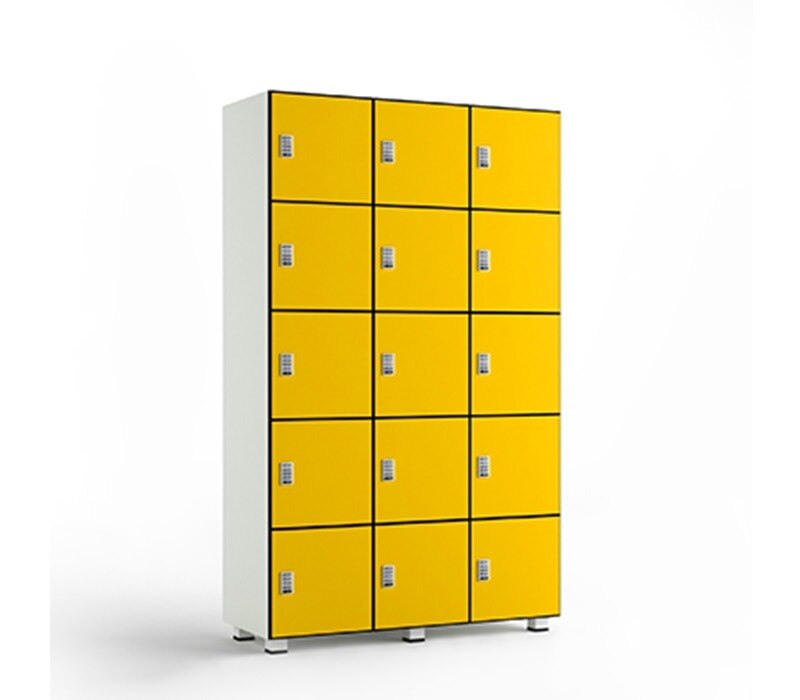
A tier is one compartment stacked vertically within a locker column, with one door intended for one user. A Z-tier bay normally serves two users through staggered compartments; a 3-tier bay serves three; a 5-tier bay serves five. More doors per bay mean less clear height and less usable volume per compartment.
| Option | Users per bay | Clear internal height and usable volume | Suitable items |
|---|---|---|---|
| Z-tier | 2 | Uneven, offset space; verify each compartment separately | Small bags, footwear and folded clothing; awkward for helmets, backpacks and long garments |
| 3-tier | 3 | Medium height and volume; the most flexible of these layouts | Backpacks, motorcycle helmets, folded workwear, footwear and uniforms |
| 5-tier | 5 | Lowest clear height and volume; highest floor-area efficiency | Footwear, personal clothing and small bags; poor for helmets, bulky PPE and long garments |
For cw tier lockers in Gujarat, and especially cw 3 tier lockers in Gujarat, treat the phrase as a product label, not a technical specification. Ask for these details:
- Overall height, width and depth, plus clear internal opening height, width and depth
- Usable volume after deducting door returns, lock housings, shelves and stiffeners
- Door count, coat hooks, shelves, ventilation openings and nameplates for each compartment
- Steel grade, sheet thickness, coating system, and welded or knock-down construction
Choose 3-tier storage when users carry helmets or bags; choose 5-tier storage only when smaller personal items justify the reduced height. A Z layout needs a compartment-by-compartment drawing.
How do tier lockers compare with other cubicle storage formats?
Z-tier storage can increase doors per bay because two staggered diagonal compartments share one full-height locker zone. The trade-off is awkward access: large bags become harder to place, long garments do not fit, usable volume is less predictable, and helmets or duffel bags can jam against the offset.
| Format | Privacy and lockability | Visibility, cleaning, ventilation, floor area and maintenance |
|---|---|---|
| Z-tier | Private, individually lockable | Low visibility; clean each offset; ventilation needs checking; dense floor use; more doors and hardware |
| Single-tier | Highest privacy; one lock per user | Poor visibility; easiest to clean; ventilation through slots; largest floor demand; simple maintenance |
| Two-tier | Private and lockable; moderate capacity | Limited visibility; easy cleaning; good ventilation; moderate floor use; routine latch maintenance |
| Cube | Private only if doors and locks are fitted | Visible sides; easy cleaning; compact footprint; joints and locks need inspection |
| Open-shelf | No privacy or lockability | Fully visible, ventilated and easy to clean; smallest footprint; exposed items collect dust |
| Wire | Low privacy; lockability depends on doors | Excellent visibility and airflow; cleaning is easy; compact; wire and welds need checking |
| Metal | Private and lockable when enclosed | Ventilation slots help; wipe-clean; durable footprint; inspect rust, welds and coating |
| Plastic | Private and lockable in enclosed models | Corrosion-resistant and easy to wash; airflow depends on vents; moderate footprint; inspect hinges and cracking |
| Bench-integrated | Usually open or shared storage | Convenient for small items; easy access; saves floor area; benches and fixings need cleaning |
Choose cw z tier lockers in gujarat for high door density only after testing real bags. cw 5 tier lockers in gujarat suit clothing, footwear and small bags; 3-tier storage gives helmets, backpacks and folded workwear more flexible height.
Hooks, cubicle-mounted shelves and overhead racks suit small items, but they do not provide individually owned, lockable storage.
How many lockers does your changing room actually need?
You need enough lockers for the maximum simultaneous users, not the total headcount on the payroll.
1. Record the peak number of people changing at one time. Add staff who need storage and visitors or contractors who cannot use personal bags in the changing room.
2. Separate assigned storage from day-use storage. Give one permanently assigned locker to each user who keeps clothing, footwear or PPE on site; size day-use lockers for the peak number of unassigned users in the busiest shared shift.
3. Add spare positions for growth, cleaning and maintenance downtime. State the allowance in the brief instead of hiding it in a rounded door count.
4. Check the smallest compartment against the actual load. If a user carries a helmet, PPE, backpack and folded workwear, count only a compartment that holds those items without blocking the door; two people cannot realistically share one small compartment merely because the door count permits it.
For example, a room with 24 simultaneous workers, 3 staff members and 2 visitors needs 29 active positions. If 18 workers receive permanent lockers, plan 18 assigned lockers plus 11 day-use positions, then add the agreed spare and out-of-service allowance.
A five-door bay does not provide five useful positions when its compartments cannot accept helmets, bulky bags or PPE. Choose three-tier capacity over five-tier density when the load needs height or volume.
Will the locker bank fit, stay dry and remain serviceable on site?
Measure the room and delivery route before selecting a locker bank; a correct tier count still fails if doors block circulation or the cabinet cannot be levelled.
1. Record wall length, ceiling height, skirting depth, columns, door swings, sprinkler-head locations, ventilation outlets, floor levels and the safe door-opening clearance. Measure the aisle with every locker door open, not just the empty aisle.
2. Draw the delivery path from unloading point to installation position. Note lift dimensions, stairs, turning points, lifting restrictions and whether the bank arrives assembled or knock-down. Specify anchoring points, substrate type and levelling requirements; tall banks need restraint where building conditions, high centres of gravity or earthquake risk demand it.
3. For a shower-adjacent or toilet wet room, require a raised sealed plinth or corrosion-resistant legs. Keep the cabinet off standing water, seal the base, and protect welds, cut edges, fasteners and door bottoms. State the substrate, pretreatment, powder-coating chemistry and coating thickness; “powder coated” alone proves little.
4. Specify ventilation slots that admit air without exposing stored contents. Identify dust, cleaning-spray and splash exposure, then inspect openings and coating damage after installation. ASTM B117 and ISO 9227 salt-spray hours compare laboratory performance; they do not predict coastal Gujarat life because wet-dry cycling, marine deposits, abrasion and crevice corrosion differ on site.
Which locker and door hardware suits your security and operating routine?
Choose hardware by operating routine: high turnover favours fast reset, while assigned users value simple key control. A cam lock is convenient, but it is not a forced-entry rating; specify the door and anti-pry construction separately.
| Option | Turnover | Lost keys and auditability | Power and maintenance |
|---|---|---|---|
| Hasp-and-staple | Low | User’s padlock; no audit trail | No power; inspect staple and hasp |
| Padlock provision | Low to medium | Replace padlock; no audit trail | No power; manage ownership |
| Cam | Medium | Replace cylinder; limited audit | No power; lubricate and align |
| Coin-return | High | Coin controls access; no user audit | No power; service coin mechanism |
| Combination | Medium | Reset code; weak event history | No power; protect dial |
| Keypad | High | Code reset; audit depends on model | Batteries; plan failure override |
| RFID/electronic | High | Credential cancellation and audit logs | Batteries, network and power require backup |
Require the quote to state master-key policy, replacement-cylinder availability, keys or credentials supplied, anti-pry door construction, emergency override and service response. Acceptance testing must check door alignment, latch engagement, lock interchangeability, sharp edges, coating damage, plinth stability, ventilation, internal dimensions and replaceable doors.
What should a Gujarat locker tender and handover inspection require?
Make the tender define the locker, not merely its tier label. Treat “cw z tier lockers in gujarat”, “cw 3 tier lockers in gujarat” and “cw 5 tier lockers in gujarat” as search terms, not technical specifications.
- Selected layout, number of doors per bay, overall height, width and depth, clear internal width, height and depth, and usable volume.
- Door schedule, lock type, key or credential quantities, latch arrangement, anti-pry construction and emergency override.
- Steel grade and thickness, welded or knock-down construction, substrate, pretreatment, powder-coating chemistry and coating thickness.
- Raised sealed plinth or legs, levelling method, anchoring points, fixing substrate and ventilation-slot design.
- Delivery route, installation, alignment, debris removal, commissioning and handover drawings.
- Replacement doors, hinges, locks, cylinders, keys and fasteners, with availability periods.
- Warranty duration, exclusions, response time, site-service process and labour coverage.
Evaluate Cubicle World industries Pvt Ltd beside competing suppliers by requesting drawings, material samples or a full mock-up, not catalogue photographs or the CW label.
At handover, inspect every door for alignment, latch engagement and sharp edges; check welds and cut-outs for coating damage; verify internal dimensions; test lock interchangeability; and confirm a damaged door can be replaced without dismantling the complete bank. Ordinary lockers are not fire safes. Any fire-resistance claim requires a separately tested, rated assembly.
Related products
 | Storage Lockers PRODUCT DESCRIPTION CW lockers open up a new generation of locker rooms. View product → |
 | Storage Lockers PRODUCT DESCRIPTION CW lockers open up a new generation of locker rooms. View product → |
Frequently asked questions
What does a tier mean in a locker layout?
A tier is one vertically stacked compartment in a locker column. A Z-tier bay normally serves two users, a 3-tier bay serves three, and a 5-tier bay serves five.
How do Z-tier, 3-tier and 5-tier lockers differ?
They differ in the number of vertically arranged doors and the usable height of each compartment. More doors increase capacity but reduce clear compartment height.
How many lockers does a changing room need?
Count users present during the busiest shift, account for shift overlap, and add spare capacity for visitors, maintenance staff and future growth before selecting the number of bays.
What should a Gujarat locker tender and handover inspection include?
Specify dimensions, material and finish, anchoring, ventilation, lock type, corrosion protection, delivery documents and a site inspection covering alignment, door operation, keys and damage.
Related product
 | Storage Lockers PRODUCT DESCRIPTION CW lockers open up a new generation of locker rooms. View product → |