Humidity alone does not tell you which cubicle hardware will survive: condensation, shower spray, chlorinated wash-downs and standing water attack different parts of the assembly. By the end, you will know how to specify each component, what information to give the supplier, how the package should arrive and which defects to reject before installation.
Key takeaways
- Record splash, condensation, hose-downs and standing water separately.
- Specify hinges, brackets, fixings and floor anchors as one assembly.
- Match stainless steel grade and coatings to cleaning chemicals.
- Demand drawings, material details and inspection records before installation.
Start with the actual moisture exposure, not the room name
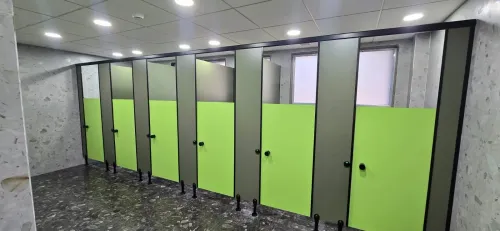
Classify the facility by what reaches the cubicle partition, not by calling it a restroom or locker room. Record ambient relative humidity, condensation, shower splash, hose-down cleaning and standing water separately; each attacks fasteners, floor fixings, panel edges and concealed cavities differently.
Compact laminate handles persistent humidity better than melamine-faced particleboard, but unsealed drill holes and damaged edges can still admit water.
| Exposure | Hardware implication | Classification |
|---|---|---|
| High humidity without wetting | 304 stainless steel or suitable nylon; protect cut edges | Damp facility |
| Condensation or regular splash | 304 stainless steel, sealed edges and raised floor fixings | Wet facility |
| Chlorinated wash-down, salt air or standing water | Prefer 316 stainless steel; verify chemical compatibility | Aggressive wet facility |
| Steam, spray and frequent impact | Specify corrosion-resistant hardware with a stated duty class | Heavy-duty wet facility |
Do not accept “stainless hardware included” as a specification. Ask for:
- Base material and grade for hinges, brackets, feet, latches, screws and washers
- Concealed-fixing material, surface finish, panel thickness and edge treatment
- Floor-clearance detail, drainage around feet and compatibility with cleaning chemicals
- Door cycle or duty classification where available
- ISO 9227 salt-spray results as finish comparisons, not promised restroom service years
Untreated mild steel, zinc die-cast and decorative chrome can fail before the panels. Require the schedule to state whether those parts are excluded, upgraded to 304 or 316 stainless steel, or replaced with nylon, acetal or glass-filled polymer.
Specify every hardware component as part of one assembly
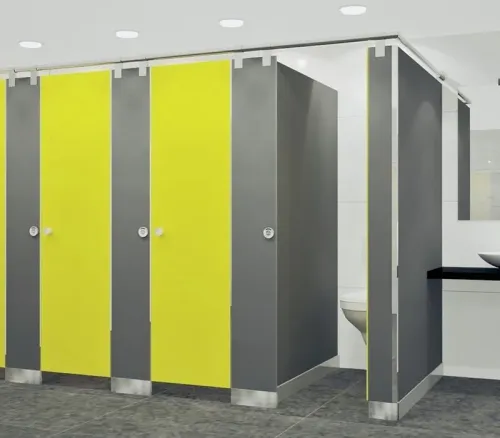
Price the cubicle partition as one matched assembly, not as panels plus miscellaneous hardware. Door mass, panel thickness, handing, closing force and drilling dimensions determine whether the hinges, latch and keep plate work together; a similar-looking substitute can leave oversized holes or a door that will not adjust.
Name the grade or material of every exposed and concealed metal part. The least corrosion-resistant screw, spring, pin or washer can determine the assembly’s service life.
| Component | Must appear in the supply | Compatibility or site detail |
|---|---|---|
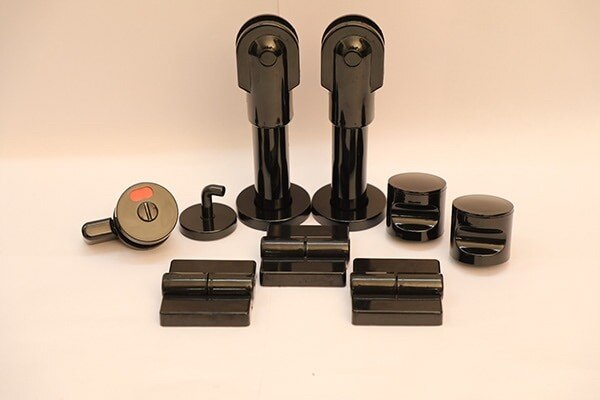
| Hinges | Matched hinges with pins, springs and mounting screws | State door load, handing, panel thickness and approved drilling pattern |
| Brackets and pilasters | Panel-to-wall, panel-to-pilaster and pilaster-to-floor brackets | Include covers and grade for concealed plates and fasteners |
| Adjustable feet | Corrosion-resistant feet, base plates and lock nuts | Keep panel edges above standing water; exclude absorbent packers |
| Latches and indicator bolts | Complete latch, keep plate, indicator bolt, escutcheon and handle | Confirm privacy function, bolt travel and strike alignment |
| Fixings | Screws, washers, nuts and wall or floor anchors | Specify metal grade, anchor type, substrate and edge distance |
| Wall and floor channels | Channels, end caps, seals and channel fixings | Provide a cleanable, drainable junction without trapped water |
Request matching spare hinges, latch mechanisms, indicator-bolt parts, washers, feet and proprietary caps against the original system part number or approved template. Do not accept a package labelled only “stainless hardware.”
Compare grades and materials against the chemicals and water present
Choose 304 stainless steel for ordinary interior washrooms; choose 316 when chlorides, salt or aggressive cleaning make corrosion more likely. The correct choice depends on what stays wet and what the cleaning team applies.
| Option | What it withstands | When it applies |
|---|---|---|
| 304 stainless steel | Humidity, splashing and routine washroom cleaners | Standard indoor washrooms without persistent chloride exposure |
| 316 stainless steel | Humidity plus stronger chloride resistance | Pool changing rooms, coastal buildings, salt-storage areas and frequent hypochlorite cleaning |
| Nylon, acetal or glass-filled polymer | Water and many cleaning chemicals without metal corrosion | Handles, spacers, guides and other non-load-bearing parts; confirm chemical compatibility |
| Aluminium | Low weight and ordinary moisture, especially with a sound anodised finish | Dry-to-damp interiors; avoid standing water, salt deposits and damaged coatings |
| Zinc die-cast, untreated mild steel or decorative chrome | Limited resistance after the finish is breached | Exclude from high-humidity packages unless the supplier provides a verified upgrade |
Neither stainless grade is immune to tea staining or pitting. Wet deposits, oxygen-starved crevices, concentrated hypochlorite and hydrochloric-acid descalers can damage both; require dilution, contact-time and rinsing limits from the hardware maker.
Mixed metals need isolation, not merely stainless screws. Use nonconductive washers, compatible coatings, drainage and details that prevent permanent wet crevices where stainless meets aluminium or zinc. Specify the base material, grade, finish and chemical-cleaning compatibility for every part. A cubicle manufacturer that writes only “stainless hardware included” has not supplied a checkable material specification.
Give the supplier the site data and demand a documented package
A two-millimetre site error can leave a door rubbing, a latch misaligned or a fixing too close to a panel edge. Give the cubicle supplier a measured survey showing room dimensions, wall positions, wall plumb, floor levels, drain locations, finished floor height, ceiling height and every door swing or service obstruction.
Before release, require a documented package containing:
1. A component schedule naming each hinge, bracket, pilaster, foot, indicator bolt, handle, channel, screw, washer, anchor and cover cap, with quantity and part number.
2. A material schedule identifying the grade of every exposed and concealed metal item, surface finish, fastener grade, nylon or aluminium type, cleaning-chemical compatibility and door-duty classification where available.
3. Dimensioned plan, elevation and section drawings showing panel thickness, hole patterns, edge treatment, fixing substrates, wall and floor channels, floor clearance, adjustable-foot range and the cleanable, drainable panel-to-floor detail.
4. Installation instructions stating approved fixings, drilling sizes, edge distances, adjustment limits and the substitutions that are prohibited.
5. Labels on cartons and individual parts showing room or cubicle location, drawing reference, part number, grade and finish. Unmarked “stainless hardware” cannot be checked on site.
6. A spare-parts and replenishment schedule covering matching hinges, latch mechanisms, indicator-bolt parts, feet, washers and proprietary caps.
Whether you appoint Cubicle World industries Pvt Ltd or another cubicle dealer, make acceptance depend on these documents, not on a generic quotation. Request salt-spray results under ISO 9227 only for finish comparison; they do not promise a number of restroom service years.
Related products
 | CUBICAL HARDWARE Nylon series Hardware View product → |
 | Restroom Cubicles PRODUCT DESCRIPTION CW Leg Series in Stainless Steel variant is developed for providing higher endurance and spectacular design. View product → |
Inspect the delivery before the installer drills or fixes anything
Before drilling, compare the delivery with the approved drawings and packing list. Check panel and door dimensions, hole positions, edge distances, finish, labels and every hardware grade. Inspect threads, welds, seals, washers, cover caps and protective coatings for scratches, distortion or corrosion.
A restroom cubicle supplier should provide batch or lot references and installation instructions before anyone makes a hole. If a bracket, latch or hinge differs from the drawing, quarantine it: a near-match can leave an oversized hole or prevent door adjustment.
- Photograph each package before opening it, then match its contents to the room-by-room hardware schedule.
- Confirm that concealed fixings, wall and floor channels, anchors, shims and adjustment screws are present; missing small parts can stop an installation.
- Check that stainless grades are stated for exposed and concealed metal, rather than accepting “stainless hardware” as a complete description.
- Reject water-damaged cartons, mixed finishes and unlabelled substitutions until the supplier confirms compatibility in writing.
Hold matching replacements, not generic alternatives.
| Component | Keep in stock | Why |
|---|---|---|
| Hinges and brackets | One complete set per installation zone | Hole patterns and finishes differ |
| Latches and indicator-bolt parts | Two complete mechanisms | Washroom traffic can disable the lock |
| Adjustable feet and anchors | Several matching sets | Wet floors accelerate loss and seizure |
| Washers, screws and cover caps | A replenishment box | Small missing parts delay repairs |
| Replacement schedule | Request it with the order | It identifies future-compatible parts |
Frequently asked questions
What moisture exposure data should you give a cubicle supplier?
Provide ambient relative humidity, condensation frequency, shower splash, hose-down cleaning, standing water, drainage conditions and the cleaning chemicals used.
Which cubicle hardware components must be specified together?
Specify hinges, indicator bolts, brackets, fasteners, legs, floor anchors, wall fixings and concealed components as one compatible assembly.
How do you choose hardware materials for a humid facility?
Compare stainless steel grades, coatings and fastener materials with the facility’s water quality, disinfectants, chlorine exposure and cleaning method.
What should you inspect before installing a cubicle partition?
Check quantities, dimensions, material grades, surface finish, corrosion, damaged threads, missing fixings, drawings and documentation before drilling or fixing.
Related product
 | Presenting serenity and simplicity at its finest, the CW shine Nylon series is the typical model for restroom cubicles which provide easy... View product → |